
Summer Feed Mold Issues? It Might Not Be Your Formula—Check Your Cooler First

Ⅰ.The Short Story
Every summer, feed mills blame mold on formulas, raw materials, or mold inhibitors.
But in over 60% of cases we have seen across 40+ countries, the real problem is a poorly adjusted cooler.
Not the recipe. Not the ingredients. The cooling step.
Ⅱ.One Case That Says It All
Southeast Asia. Shrimp feed. Ambient temperature: 31°C.
The mill had mold issues within 10 days of storage. They changed inhibitors. They tweaked formulas. Nothing worked.
Our engineer walked in, pointed a thermometer at the cooler discharge—47°C.
Industry standard: ambient + ≤3°C = 34°C maximum.
Every pellet was packed with 13°C of trapped heat. Inside the bags, heat turned to moisture. Moisture fed mold.
They adjusted airflow and discharge speed. Three days later: 33.5°C.
Same formula. Same inhibitor. No more mold.
Ⅲ.The Cooler's Real Job
Most people think a cooler just "blows air" on hot pellets.
It does much more:
What It Must Do | Target |
Lower temperature | Ambient + ≤3°C |
Lower moisture | 12–13% (from 17–18%) |
Do this uniformly | Every pellet, not just the surface |
Uniformity is the hard part.
Uneven airflow or poor discharge control creates a mix: some pellets over-dried and cracked, others still wet and warm inside. You can't see it. But mold finds it within 72 hours.
Ⅳ.Three Quick Checks for This Summer
1. Measure discharge temperature 3x daily
Morning, midday, evening.
If pellets feel warm to your palm (>37°C), your cooler is underperforming.
2. Summer settings ≠ Winter settings
Summer air is humid—it carries less moisture away. If you run winter parameters in July, you are using a damp towel to dry a damp towel.
Adjust: more airflow, thinner bed depth, faster discharge.
3. Watch the first and last batches
Airflow and material flow are unstable at start-up and shut-down. These batches are high-risk. Monitor them closely.
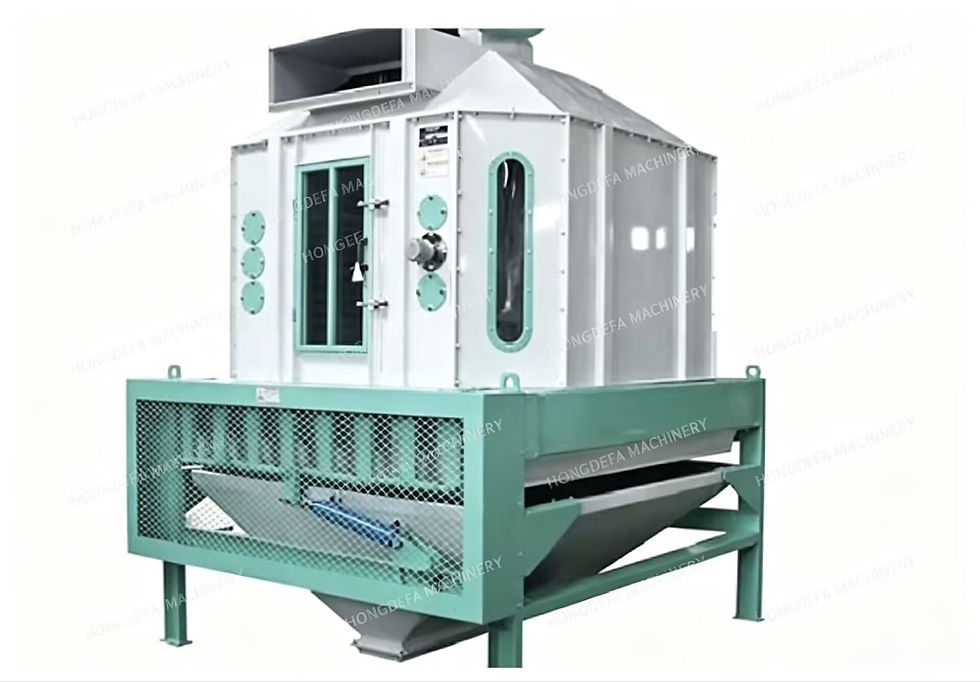
Counterflow design — air moves upward through the entire pellet bed. No dead zones. No shortcuts.
VFD discharge control — precise retention time (6–10 minutes) for consistent results.
Built for any climate — from Russia to the tropics. Anti-condensation. Stainless steel liners. Reliable anywhere.
Ⅵ.Is This You?
☐ Shorter feed shelf life in summer
☐ Quality swings between seasons
☐ Discharge temperature consistently above ambient +3°C
☐ Cracked pellets or high fines
We offer free remote diagnostics via video call. No charge. No obligation.
Because if we cannot pinpoint your root cause, we do not deserve to sell you a solution.
Ⅶ.Final Line
Before you change your formula or switch inhibitors this summer, walk to your cooler.
Put your hand on the discharge.
If it feels warm, your problem is not on the formula sheet.
Your cooler is asking for help.
And Hongdefa is ready to assist—with expertise, honesty, and a commitment to your stable production.
We don't just sell equipment. We stand behind it.


Comments