
Cow Feed vs Chicken Feed: Why You Cannot Use the Same Machine Settings

Introduction: One Machine, Different Animals, Different Needs
Many new feed mill investors ask a common question:
“Can we use the same machine settings to produce both cow feed and chicken feed?”
The answer is: No, not if you want good feed quality and better animal performance.
Although both cow feed and chicken feed are made from similar raw materials, such as maize, soybean meal, wheat bran, and other grains, their nutritional requirements, particle sizes, and processing methods are different.
Using the wrong machine settings may lead to:
Poor feed quality
Lower animal growth performance
More feed waste
Higher production costs
A professional feed production system must be adjusted according to the target animal.
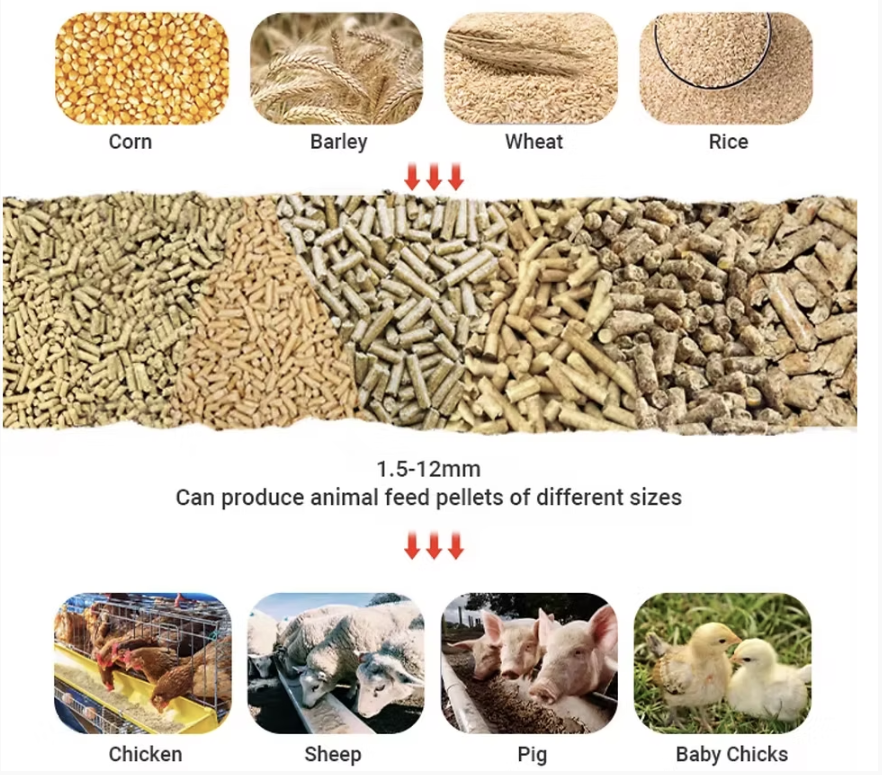
1.Different Animals Need Different Feed Sizes
Chicken Feed: Smaller and More Uniform Particles
Chickens have a smaller digestive system compared with cattle. They require feed particles that are easier to eat and digest.
For chicken feed production:
Raw materials usually need finer grinding
Particle size should be more uniform
Better mixing is required to ensure every bird receives balanced nutrition
For example:
Broilers need feed that supports fast growth
Layers need feed that supports egg production
If the particles are too large, chickens may have difficulty eating and digesting the feed.
2.Cow Feed: Larger Particles for Better Digestion
Cattle are ruminants with a special digestive system. They need enough fiber structure to support rumen health.
Cow feed usually requires:
Larger particle size
More roughage materials
Proper fiber length
If cow feed is ground too finely like chicken feed, it may reduce chewing activity and affect digestion.
Therefore, the grinding process cannot use the same settings.
3.Grinding Machine Settings Are Different
The grinding process is one of the most important steps in feed production.
For Chicken Feed
The hammer mill or grinder usually works with:
Smaller screen holes
Higher grinding fineness
More uniform powder
The purpose is to produce feed that chickens can easily consume.
For Cow Feed
The grinding setting is usually:
Larger screen holes
Coarser particles
More consideration for fiber retention
The goal is not only to make the feed smaller but also to maintain proper structure.
4.Pelleting Conditions Are Also Different
Many feed factories use pellet machines to produce pellets.
However, cow feed and chicken feed do not use exactly the same pellet parameters.
Chicken Feed Pellets
Chicken pellets normally require:
Smaller pellet diameter
Higher pellet quality
Less powder after production
Common sizes: 2mm 3mm 4mm
Cow Feed Pellets
Cattle usually accept larger pellets because of their larger mouth size.
Common features:
Larger pellet diameter
Higher fiber content
Stronger pellet structure
Common sizes:6mm 8mm 10mm
The die size, compression ratio, and production speed may need adjustment.
5.Raw Materials Also Affect Machine Settings
The same machine may process different formulas, but the settings should change according to raw materials.
For example:
Chicken Feed Formula:
Maize
Soybean meal
Fish meal
Vitamins and minerals
Usually needs fine grinding and accurate mixing.
Cow Feed Formula:
Maize
Grass
Hay
Wheat bran
Other fiber materials
Usually needs more attention to fiber structure.
Different formulas require different processing methods.
6.What Happens If You Use the Wrong Settings?
Using chicken feed settings for cow feed or cow feed settings for chicken feed may cause problems:
Problem 1: Poor Feed Efficiency
Animals cannot fully digest the nutrients.
Problem 2: More Production Loss
Too much powder or broken pellets may increase waste.
Problem 3: Lower Animal Performance
Feed quality directly affects growth, milk production, and egg production.
Problem 4: Higher Operating Cost
Wrong settings can increase energy consumption and reduce production efficiency.
7.Can One Feed Mill Produce Both Cow Feed and Chicken Feed?
Yes, it is possible.A modern feed mill can produce different types of animal feed by adjusting:
Grinding fineness
Mixing time
Pellet die size
Production parameters
Formula settings
The key is not using one fixed setting for all animals.
A professional feed production line should be flexible and designed according to the customer's market needs.
8.Conclusion: The Right Settings Create Better Feed
Cow feed and chicken feed may use similar ingredients, but they are designed for completely different animals.
A successful feed mill does not only depend on having good machines. It also depends on:
✔ Correct processing technology✔ Proper machine adjustment✔ Suitable feed formulas✔ Understanding animal nutrition needs
Before investing in a feed production line, it is important to define:
Which animals you will produce feed for
Your expected capacity
Your raw materials
Your final feed products
With the right design and settings, one feed mill can produce high-quality feed for different markets and create better business value.

Hongdefa Machinery provides professional feed processing solutions with customized designs according to customers' raw materials, capacity requirements, and target animal feed products.


Comments